
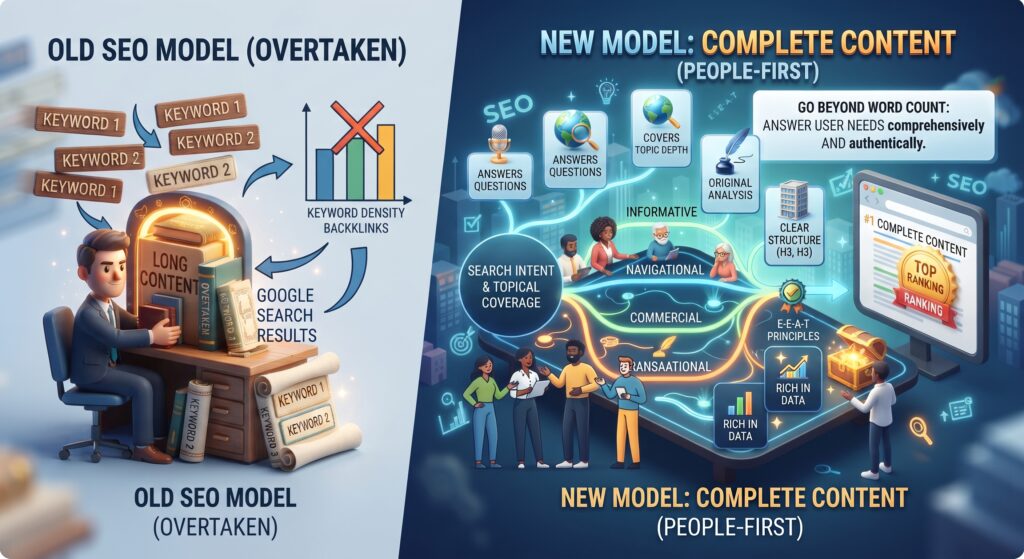
The Old SEO Model No Longer Cuts It
For years, the formula for ranking well on Google was relatively simple: find a keyword, use it several times throughout the text, add a few subheadings, and hit publish. This approach worked because search algorithms relied heavily on surface-level signals: keyword density, text length, and backlinks.
Today, that model is obsolete. Google, through its Google for Developers guidelines, has repeatedly emphasized that content must be created for people, not algorithms. The Helpful Content Update, rolled out globally, was designed precisely for this: to demote content written solely to “game” search without offering real value to the reader.
As a result, pages with thousands of words but no substance are losing ground to targeted, comprehensive content.
Complete Content Does Not Mean Long Content
One of the most common misconceptions in SEO is that “complete” content equals “long” content. In reality, the two have nothing to do with each other.
A 3,000-word article that circles around the same point without adding new insights isn’t complete—it’s just long. Conversely, a 900-word piece that clearly and sharply answers every question a user has can be extremely complete.
Completeness is measured by topical depth, not word count. Every single sentence should add value: an answer, an example, a clarification, or a comparison. When text is artificially padded, both readers and search engines notice instantly.
Everything Starts with Search Intent
Before writing a single word, you need to understand why the user is performing that search. This is search intent, and it is the baseline for every comprehensive piece of writing.
There are four core intent categories:
- Informational: The user wants to learn something (e.g., “what is SEO”)
- Navigational: The user is looking for a specific website or brand
- Commercial: The user is comparing options before making a purchase
- Transactional: The user is ready to buy or take action
If your content fails to match the underlying intent, no amount of keyword stuffing will help it rank. Someone searching for “best CRM for small businesses” doesn’t want a history of CRM software—they want a direct comparison of choices.
One Keyword Hides Dozens of Questions
Behind every single keyword lies a cluster of related questions that the user likely has, even if they didn’t explicitly type them.
For example, someone searching “how SEO works” might also be wondering:
- How long does SEO take to show results?
- What is the difference between on-page and off-page SEO?
- Do I need an expert or can I do it myself?
Tools like Semrush and Ahrefs help uncover these exact queries. An article that ignores these secondary questions forces the reader to look elsewhere—a clear signal to Google that the content was insufficient.
Shifting From Keywords to Topical Coverage
The step beyond keywords is topical coverage. Instead of asking, “What keyword should I insert?” ask, “What does someone need to know to fully understand this topic?”
This mindset shift produces organic, useful content. Instead of repeating “athlete nutrition” ten times, you write an article explaining protein needs, carbohydrate timing, meal schedules, and sport-specific differences.
Topical coverage doesn’t mean cramming everything into a single massive page. Often, a topic cluster strategy works best—a comprehensive pillar page linked to supporting sub-articles.
Content Structure Matters More Than Ever
The flow of information dictates both user experience and how AI/search engines parse your text.
A strong structure includes:
- Clear headings (H2, H3) that outline each section
- Short paragraphs designed for rapid skimming
- Lists and tables for data organization
- Logical flow, moving from general concepts to specific solutions
Structure isn’t just an aesthetic choice; AI systems use it to map which section answers a specific user query.
Completeness Without Originality Falls Short
Even the most thorough article will fail if it merely regurgitates what is already web-wide. Google actively hunts for content that adds fresh value: first-hand experience, original analysis, real-world case studies, or a unique perspective.
This ties directly into E-E-A-T (Experience, Expertise, Authoritativeness, Trustworthiness). Demonstrating genuine expertise separates your piece from generic automated rewrites.
What Bad SEO Content Looks Like
To avoid wasting effort, steer clear of these pitfalls:
- Text overloaded with keywords at the expense of natural flow
- Superficial coverage that leaves core questions unanswered
- Copied or lightly paraphrased text from competing sites
- Inflated length with zero substance
- Endless walls of text lacking subheadings or lists
How to Create Truly Comprehensive Content (7 Stages)
- Search Intent Research: Decode what the user actually wants to achieve.
- Sub-question Analysis: Map out secondary questions hiding behind the core topic.
- Topical Mapping: Decide whether to cover sub-topics inline or via clusters.
- Outline Creation: Organize information logically with clear subheaders.
- Original Writing: Inject real examples, personal insights, or unique data.
- Completeness Check: Verify that no crucial reader questions remain open.
- Optimization & Refresh: Regularly update data as user needs evolve.
What Changes with AI Search?
The rise of Google AI Overviews and generative search means content is extracted and summarized directly. To thrive here, your writing must be:
- Clear and standalone: Sentences should make sense even when extracted.
- Q&A-driven: Mimicking how humans query AI tools.
- Data-rich: Backed by concrete facts rather than vague fluff.
If you want to see how well your own content answers your customers’ questions, run the free SEO check or write to us via contact. We do not promise rankings; we show you what is missing and in what order to work on it.
Frequently Asked Questions
What does “complete content” mean in SEO?
It means thoroughly covering the search intent by answering all related user questions, regardless of length.
Does long-form content always outrank short-form content?
No. Word count is not a direct ranking factor. A concise, hard-hitting article can easily outperform bloated text.
What is topical coverage?
It is the breadth of coverage a piece or cluster gives to a subject, minimizing unanswered reader questions.
How does AI Search affect content writing?
AI engines extract direct snippets, requiring clear, standalone sentences and structured Q&A formats.
What is the first step to writing better content?
Understanding the search intent behind your target keyword before drafting a single word.