
The challenge
e-HowTo.gr was already a known Greek site for practical information, with almost 10,000 articles and a Google News presence. The stack around it had become the problem.
- It ran on a heavy commercial theme, Pixwell, with many plugins. Rank Math and Newsroom OS were both outputting schema, so the markup was duplicated and the site was slow.
- Visibility in Google Search and Discover had dropped after core updates. Some headlines used a clickbait pattern that the algorithm now pushes down.
- Turning a public-body announcement into an article was manual work.
- Mobile PageSpeed on articles sat around 57–60/100, and INP was about 290 ms on more than 1,000 URLs.
The approach
We rebuilt the site on four pillars: a light custom theme, one plugin that replaces most third-party plugins, a controlled AI draft for news, and pages that can be quoted by classic search and by AI answers.
The work happened on staging first, then moved to the live site.
A custom theme, designed for a phone
The new homepage leads with one story, chosen through a tag, and then splits into sections: E-GOV, Life, Technology, Travel. The header stays put. Search sits in it. A live ticker carries items from official bodies.
- Templates for articles, categories, tags, authors, search and the 404, drawn for mobile first.
- Transparency pages for E-E-A-T: who they are, publishing principles, contact, and author pages with a real bio.
- Related reading inside the article and a smarter match at the end, plus a table of contents.
- Pagination that does not jump from 1 to 222.
One plugin for the whole site
The plugin replaced Rank Math, Newsroom OS and a row of helper plugins. One panel sets the homepage order, where each AdSense unit sits, header and footer code, API keys and the AI prompts. Prompts can change without a developer.
Ad slots are tied to a paragraph, and empty slots collapse so the page does not jump. That is the CLS control.
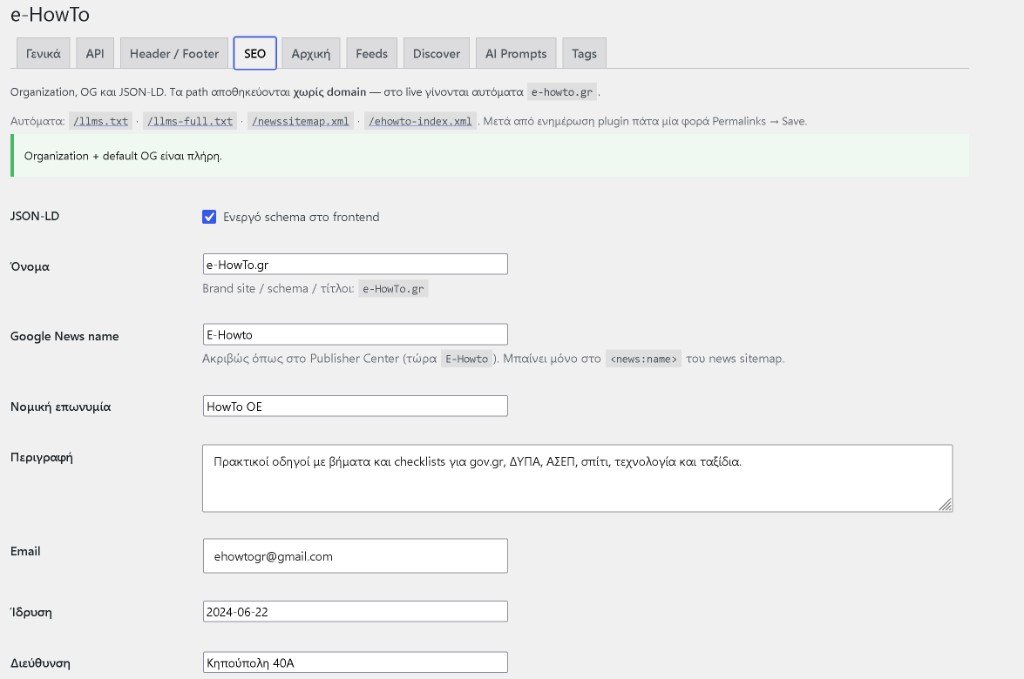
Our own SEO and schema
Titles, meta descriptions and Open Graph come from one system, with the same brand across the site. On each article the editor chooses NewsArticle or Article. The site also publishes Organization, WebSite, Person with sameAs, BreadcrumbList and ItemList. HowTo and FAQ markup were removed, because Google no longer uses them.
- A Google News sitemap that follows the Publisher Center rules, a sitemap of about 10,000 articles, and a separate sitemap for the tools.
- Discover images are cropped to 1200×675. max-image-preview is large. The logo is not used as the share image. There is a Google Preferred Sources button.
- Thin archives are noindex. Old AMP URLs redirect. robots.txt is clean. IndexNow tells Bing, and through it Copilot and ChatGPT Search, when something is published.
From an official announcement to a draft
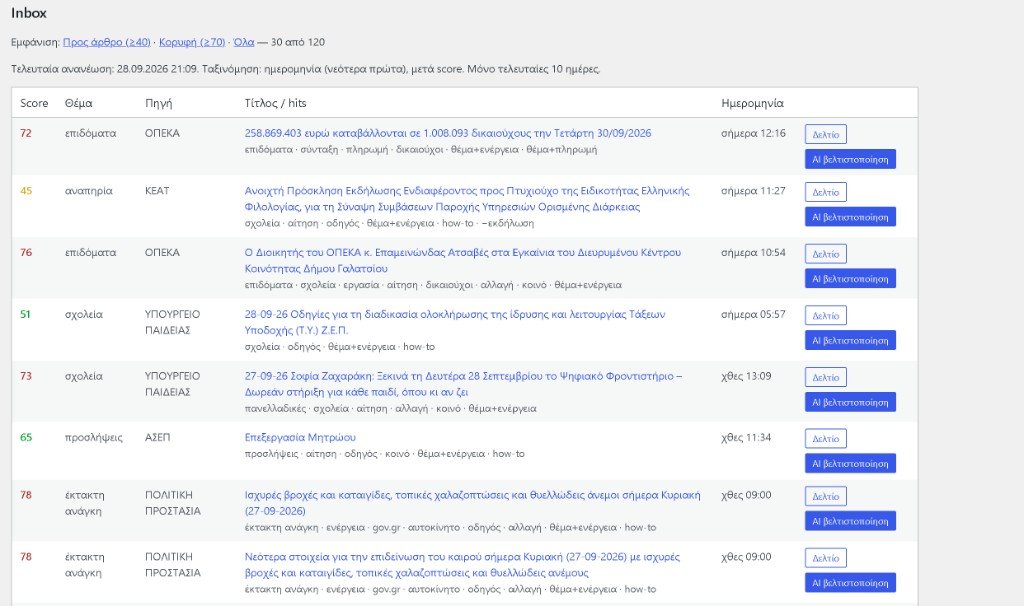
The newsroom reads RSS and HTML from official bodies such as DYPA, the tax authority and ministries. When a body blocks the server, a second server relays the feed.
A topic dictionary scores each announcement by how useful it is to a citizen. What passes the threshold lands in an inbox and on the live ticker. One click asks Gemini for a full news draft. The editor checks it. The model does not invent a missing fact: the gap is marked for the editor, and the source body is named.
Internal links to tools, guides and articles are added by code, not by the model. A Discover radar watches current Google News topics with its own prompt. Feeds refresh hourly, and the AI calls have a monthly cap.
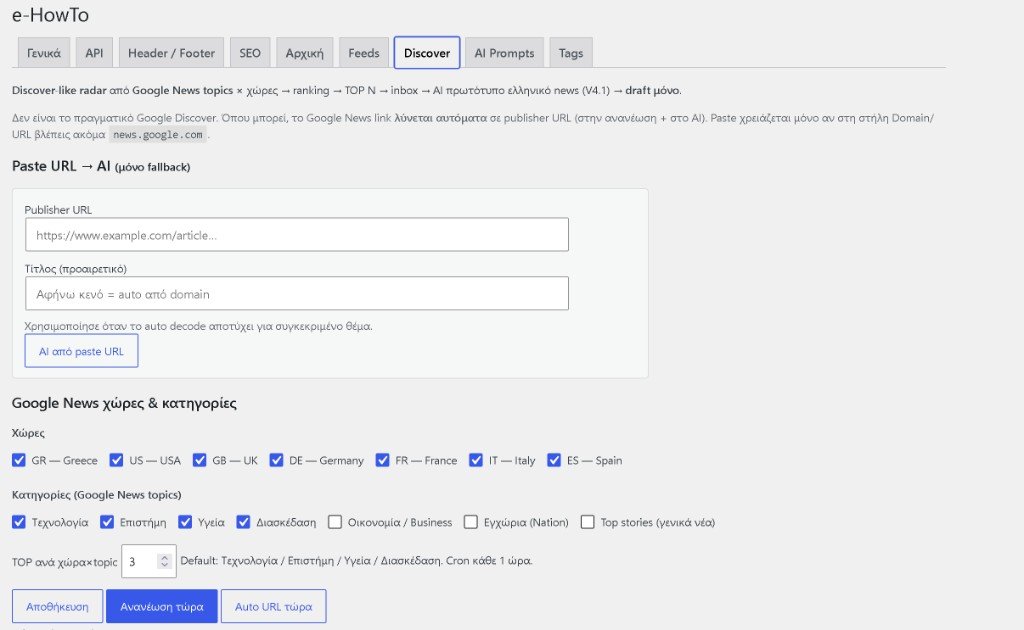
Discover radar
The same plugin watches Google News topics by country and category, ranks them, and can turn a chosen URL into a draft. It is a radar, not a claim that Google Discover will feature the site.
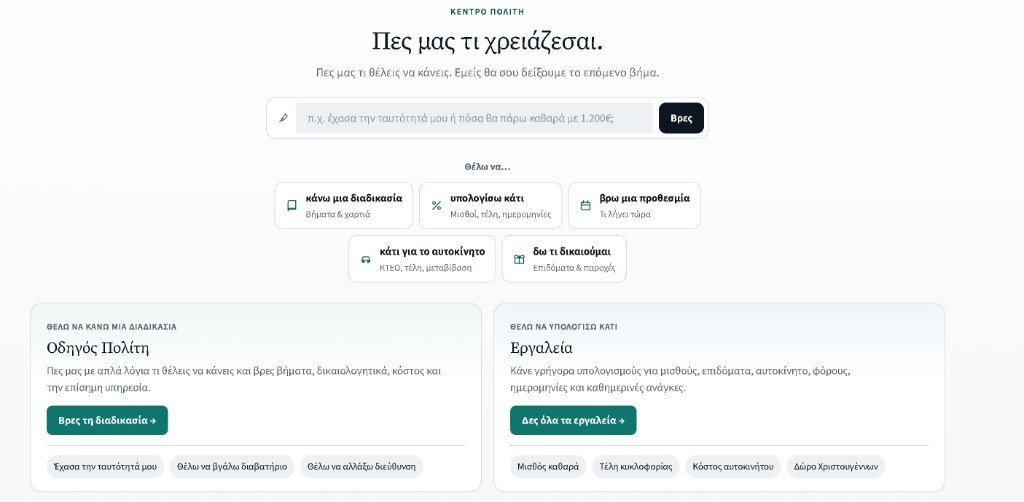
A citizen desk: tools and guides
Twenty-two calculators use official sources and a written method: net salary, university-entry points, vehicle inspection, road tax, holiday bonuses, VAT, severance, overtime, imputed income and others. A QA dashboard checks that the calculations still come out right.
The citizen guide covers 30 well-used gov.gr services: the steps, the papers, and where to go. The homepage search asks “tell us what you need” and routes the person to a procedure or a tool.
Speed and Core Web Vitals
LiteSpeed Cache is in place, fonts are local, and render-blocking files were cut back. A sidebar ad was what dragged the mobile score down. After it was placed correctly, article pages in the lab moved from about 57–60 to 95–97 out of 100.
The INP problem was an animation that kept running even when it was hidden. It was rewritten so it does not load the main thread. Search Console still needs 28 days of field data before that fix can be called confirmed. We are not publishing a new INP number.
Cache now clears only what a new article changes, and relative times such as “5 minutes ago” stay correct on cached pages.
Content, from 16 months of data
We read 16 months of Search Console, both Search and Discover. Seventy-two URLs received a new title and lead, without a clickbait gap, plus a new meta description and the right schema. No URL changed. Twenty of the strongest articles were rewritten with facts that are current, and published on a schedule.
Authors now have a full profile: bio, photo and social profiles in the schema.
Accessibility and agents
Search fields had ARIA labels that screen readers and the Lighthouse agent-accessibility check could not follow. Those labels were corrected.